AOD-9604 in rabbit cartilage
A different tissue gives the fragment a different job to attempt.
An experiment in rabbit knees
A fragment explored for fat metabolism turns up in a knee experiment. I enjoy this kind of unexpected turn, provided the new destination gets a proper examination of its own.
The cartilage study used 32 New Zealand white rabbits with collagenase-induced knee osteoarthritis. In other words, this was an experimentally induced disease model. The researchers compared intra-articular AOD9604, with or without hyaluronic acid, against saline control. Intra-articular means delivered inside the joint.
The treatment groups had lower gross morphological and histopathological cartilage-degeneration scores than saline controls. Those are assessments of the cartilage’s visible condition and its appearance in examined tissue. The result gives the joint experiment something concrete to discuss.
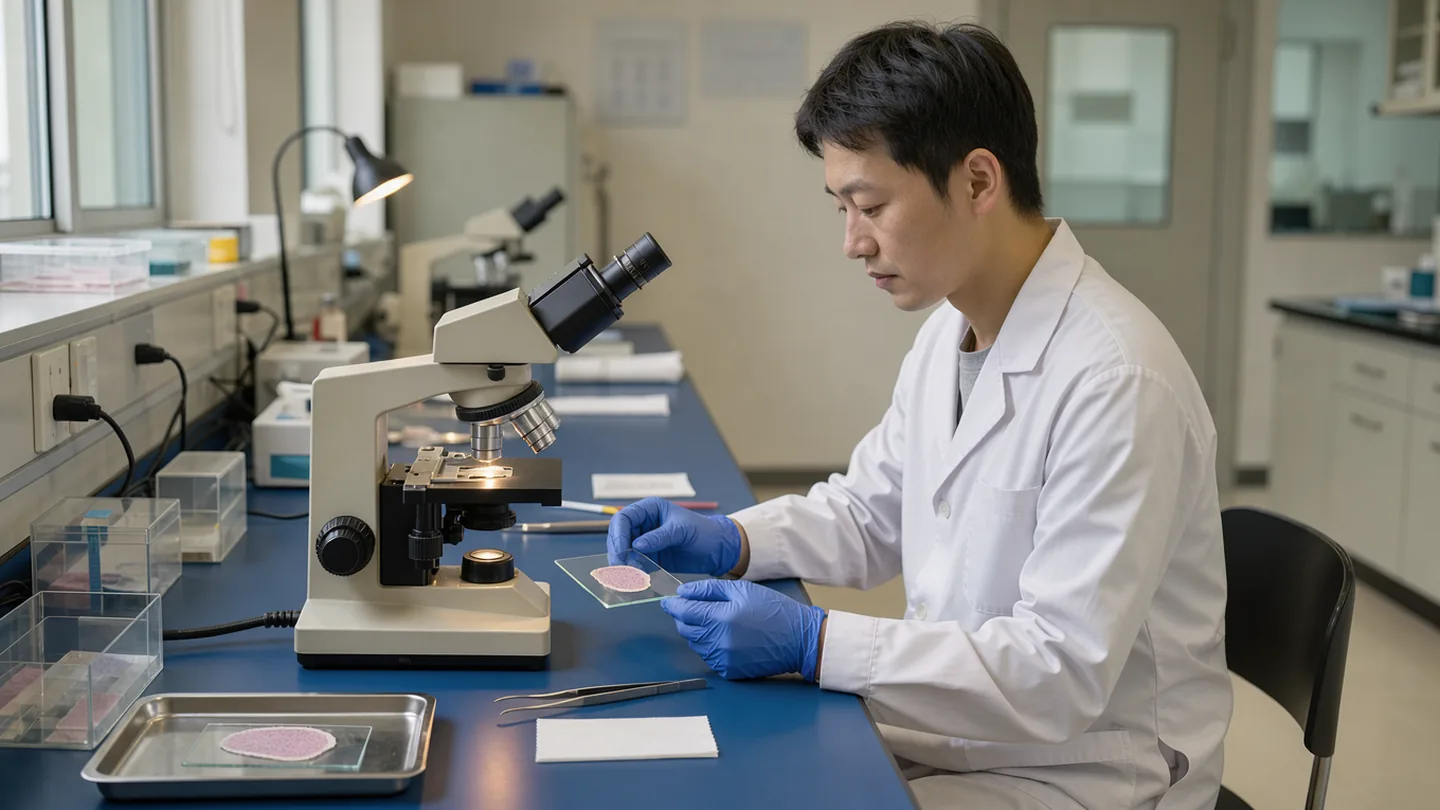
Cartilage-degeneration scores
I want the measured outcome to stay in the foreground. A lower degeneration score is an observation about cartilage in this rabbit model. The paper’s comparison concerns gross and microscopic cartilage assessments. A human pain or mobility claim would take me beyond that rabbit result.
“Joint repair” is a much roomier phrase. It invites thoughts about moving comfortably, returning to an activity or avoiding a procedure. I cannot assign those outcomes to this experiment. The cartilage score is already interesting enough without borrowing a person’s future recovery.
I rate the small, concrete result more highly than a sweeping recovery claim. A tissue measurement can lead to a useful next experiment; a sweeping recovery claim runs past the measurement before the work has begun.
Hyaluronic acid and the comparison
The study assessed AOD9604 with and without hyaluronic acid. That distinction deserves attention whenever this paper is invoked. A combination and a fragment alone are different experimental conditions.
I’m unwilling to announce that the combination was superior, or that it proved a special interaction, from the result described here. The supported account is the lower cartilage-degeneration scores against saline and the fact that both treatment approaches were assessed. A detailed comparison between the treatment groups would have to carry its own evidence.
This is the sort of small restraint that makes the factory metaphor useful to me: the parts and the assembly both need to be accounted for. Merely listing the components gives no answer about how they work together.
A human cartilage study
A human study of pain, function and safety would move the discussion toward the practical outcome I’m hoping to understand. That is a wish for a result to assess, rather than a description of an outcome already established here. For now, I regard the rabbit observation as an invitation to investigate cartilage biology.
I would also ask how the cartilage assessment relates to the experience of the whole joint. That question sets an ambition for a future experiment. A better-looking specimen is the beginning of the inquiry I’m interested in, and any claim about a person’s recovery still needs a result in people.
The fat-metabolism essay asks a different question about the fragment. Carrying the same molecule into a new tissue starts another investigation; it does not carry a completed answer along with it.